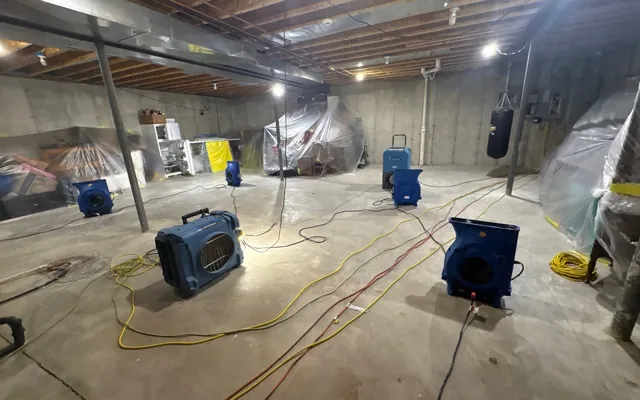
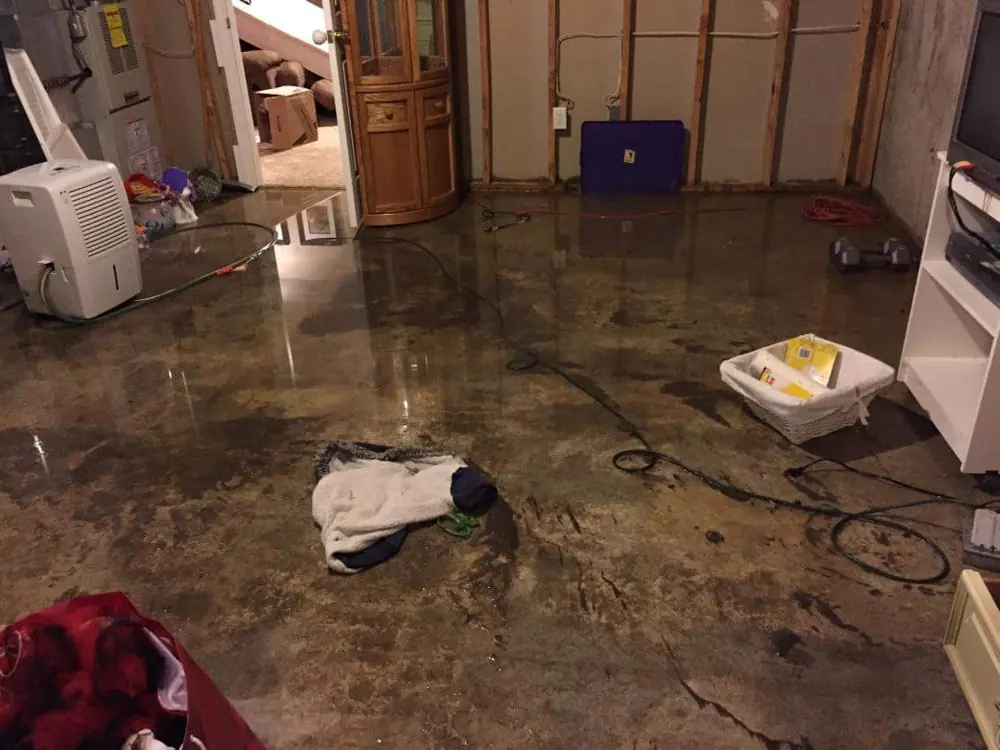
Phoenix homes are built slab-on-grade with no true basements, so flooding here fills ground-floor rooms and the rare below-grade cellar or media room. Local crews extract standing water fast and dry the slab and walls with IICRC-standard equipment.

Truck-mounted and portable pumps pull standing water off the slab or out of a below-grade room while crews take starting moisture readings across the affected area.
Air movers and dehumidifiers dry the slab, baseboards, and lower wall cavities, with moisture tracked daily until every reading returns to a safe range.
Soaked carpet pad, swollen baseboard, and wet drywall are cut out and hauled away so the structure can dry and mold has nowhere to take hold.
Crews restore the affected flooring and walls and recommend grading or drainage changes to steer future storm water away from the home.

While help is on the way, these first steps, done only where it is safe, limit the damage and protect the insurance claim.
Shut the supply off at the source, or close the home's main valve if the source is not obvious. Stopping the flow limits the damage more than anything else.
Switch off electricity to the affected area, but only if the breaker can be reached without standing in or touching the water.
Get a crew dispatched right away. The sooner extraction and drying begin, the more flooring, drywall, and belongings can be saved.
Take photos and a short video of the water and the affected rooms before anything is moved, so the insurance claim starts strong.
Ground-floor flood cleanup in Phoenix generally runs $1,500 to $7,000, driven by how much water entered, how long it sat, and whether flooring and drywall must be replaced. A rare below-grade room that must be pumped out costs more. Most homeowner policies cover sudden intrusion, and crews document the source and moisture readings so the adjuster sees the full picture.
Crews reach Phoenix and the Valley of the Sun fast, from the historic Willo and Coronado districts to Arcadia, Biltmore, and Sunnyslope, and nearby Tempe, Scottsdale, and Glendale. See the full list on the areas served across Phoenix page.
See all areas servedA real crew dispatched any hour, not a callback in the morning.
Trained technicians following recognized IICRC drying standards.
Truck-mounted, portable, and submersible for any size loss.
The loss is documented and billed to the carrier directly.
Almost none do. The Valley's homes are built slab-on-grade on desert soil, so there is nothing below the ground floor to flood. When people search for basement flooding here, they usually mean water pooling in a sunken room or the rare below-grade cellar in a custom hillside home, which this service covers.
It settles at the lowest point of the ground floor, often a sunken living room, a hallway near the garage, or a bedroom on the downhill side of the lot. Fast extraction matters because water on a slab wicks into baseboards, drywall, and carpet pad quickly.
Most slab-level floods dry in three to six days once the water is extracted and equipment is running. Crews meter the slab, baseboards, and wall cavities daily and keep drying until readings return to normal, which prevents hidden moisture and mold.
Most policies cover sudden water intrusion from a burst pipe, appliance failure, or storm event, while gradual seepage or poor maintenance may be excluded. Crews document the source, the water line, and moisture readings to support the claim.
Phoenix crews are on call 24 hours a day, local and fast, and can be on the way within the hour.
Call (623) 254-4056